-
Phone:
+91 9734975309 -
Email:
Info.loanoverseas@gmail.com -
Location:
Raipur, Chhattisgarh, India



 Study Abroad Loans
Planning to study abroad is exciting, but funding that dream degree usually starts with one question: am I eligible for an education loan? Education loan eligibility for abroad studies depends on a mix of academic performance, the university and course you have chosen, your co-applicant's financial profile, and the collateral or security you can offer. Banks and NBFCs use these factors to decide not just whether to approve your loan, but how much they will sanction and at what rate of interest.
The good news is that eligibility requirements are fairly standard across most lenders, and once you understand them, you can prepare well in advance and avoid last-minute rejections. In this guide, we break down every eligibility parameter, compare requirements across secured and unsecured loans, and share practical tips to strengthen your application before you approach a bank.
Basic Requirements
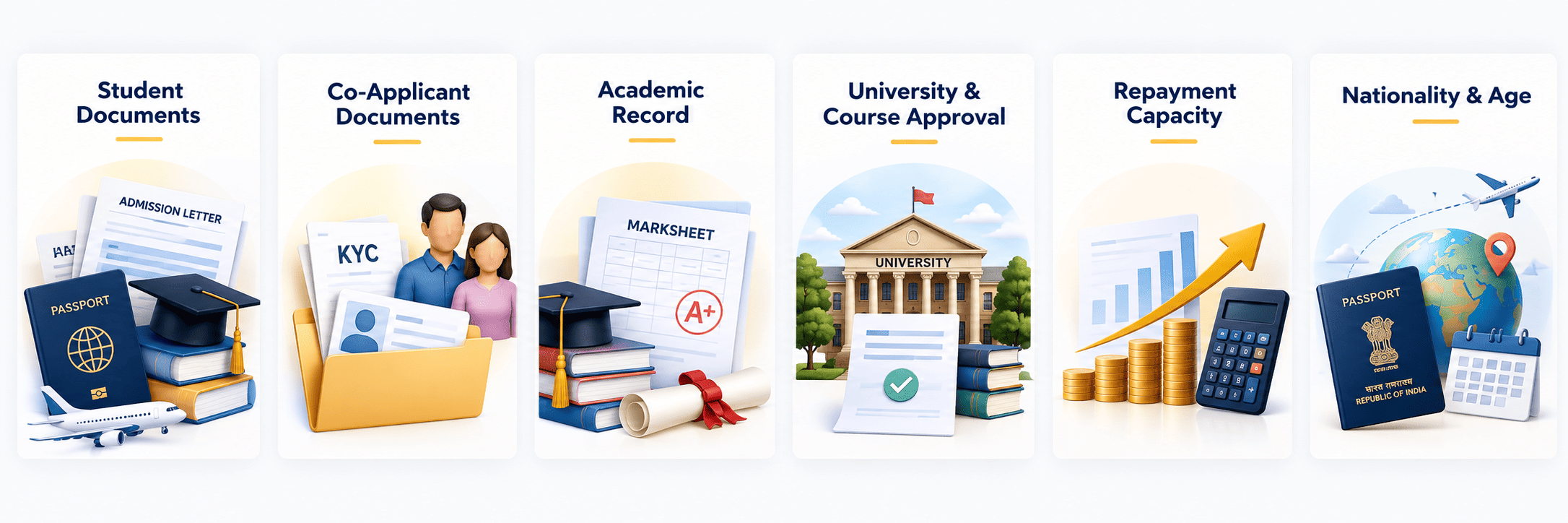
While every lender has its own internal policy, almost all banks and NBFCs evaluate the following five pillars before approving an education loan for studies abroad.

A consistent academic record with no major gaps improves approval chances significantly. Most lenders prefer at least 50-60% marks in your qualifying degree, though this can vary by course and university ranking.
The institution and program you have been admitted to must be recognised by the lender. Loans are more readily sanctioned for accredited universities and job-oriented courses like engineering, management, and medicine.
Since students rarely have independent income, banks require a co-applicant, usually a parent, spouse, or sibling, with a stable income and a healthy credit score to guarantee repayment.
For loans above a certain amount (commonly ₹7.5 lakh to ₹20 lakh depending on the lender), collateral such as property, fixed deposits, or insurance policies is required to secure the loan.
Lenders assess the combined repayment capacity of the student and co-applicant, factoring in existing loans/EMIs, expected post-study income, and the loan tenure requested.
Applicants must be Indian citizens, typically aged between 18 and 35 years, with a confirmed intent to pursue full-time education abroad rather than part-time or distance programs.
Compare & Choose
Eligibility norms differ slightly depending on whether you opt for a secured or unsecured loan, and which country you plan to study in. Use the tabs below to compare.

A secured education loan is backed by collateral such as property, fixed deposits, or securities. It is the preferred route for loan amounts above ₹7.5 lakh and usually offers lower interest rates and higher loan amounts, sometimes covering the full cost of tuition and living expenses.
Unsecured loans do not require collateral and are typically capped at ₹7.5-40 lakh depending on the lender and course. Approval relies heavily on the applicant's academic profile, the reputation of the university, and the co-applicant's income and credit history.
For the USA, UK, and Canada, lenders generally require an unconditional admission letter, proof of English proficiency (IELTS/TOEFL/PTE), and evidence of sufficient funds for the entire duration of the course, including living expenses as per visa guidelines.
Many European destinations, including Germany, offer low or no tuition fees at public universities, so loan eligibility here often focuses on covering living expenses and the blocked account requirement rather than large tuition amounts.
Paperwork Made Simple
Keeping these documents ready in advance can significantly speed up your loan sanction process.
Pro Tips
A few smart steps taken well before you apply can meaningfully increase your chances of approval and get you a better interest rate.
Choose a co-applicant with the highest stable income and cleanest credit history among your immediate family.
If you're close to the secured-loan threshold, offering collateral can unlock a lower interest rate and higher sanction amount.
Compare eligibility norms across public banks, private banks, and NBFCs to find the best fit for your profile.
A loan consultant can match you to lenders where you already meet the eligibility criteria, saving time and avoiding rejections.
Quick Answers

Ready When You Are
Understanding education loan eligibility for abroad studies well ahead of your application deadlines gives you the time to strengthen weak areas, whether that's arranging a stronger co-applicant, gathering collateral, or shortlisting lenders that match your profile. With the right preparation and expert guidance, funding your international education doesn't have to be stressful.
COUNTRIES WE COVER
No matter where you're headed, our loan consultants for abroad studies understand the lender preferences and documentation quirks specific to that country.